By Analía Perez
Usually when we read a story, we look for a narrative that we can relate to. It’s the reason why production teams meticulously craft their main character to be relatable or compelling to the audience, and why “literally me” culture has grown so prominent. In most cases, we indirectly place our consciousness into the one of the lead characters, which makes their experiences and growth resonate with the reader deeply, even if the character is deeply flawed.
Scott Pilgrim is a douchebag, he’s a stuttering, stumbling idiot with no dignity in his anger. The first chapter of the book illustrates him getting into a relationship with a Seventeen year-old girl (Knives Chau) specifically because her admiration for him makes her easy to persuade, not to mention he is only dating her to fill the void of a previous failed relationship, parades her around as if she were an object, disregards her feelings all in the first two chapters. On a first impression basis, Scott is hard to love, yet why does he create such a connection with the audience?
Scott Pilgrim Vs. The World utilizes its world building to further humanize these characters, despite it being a direct homage to action-fighting videogames (Better seen in the movie/Show) it also has a distinct sort of cozy ambience, in which you can see the characters interacting with the world much like how people do, the lives these characters lead is not an idealized hero fantasy like Scott would want it to be but rather a more realistic approach to the young-adult experience. All of these characters are flawed so humanely, they are allowed to cry, kick and scream because Scott Pilgrim Vs. The World doesn’t shy away from depicting the ugly parts within us, it embraces them.
And this is what leads me to believe that Scott Pilgrim is symbolic of human growth.
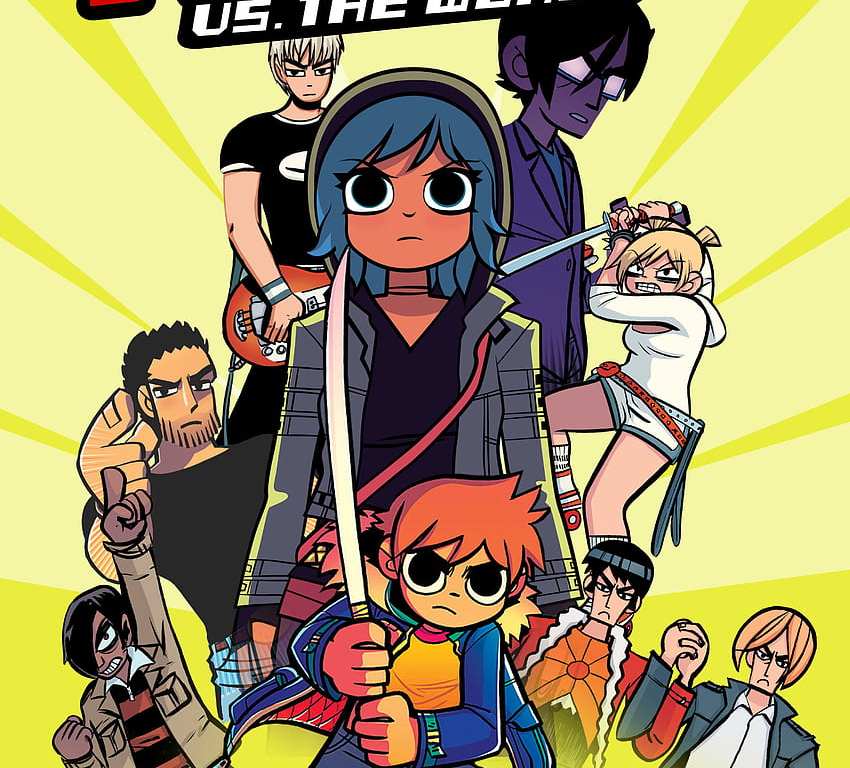
The main plot of Scott Pilgrim Vs. The World follows Scott Pilgrim falling in love with Ramona Flowers, the main romantic interest of the story, and also a catalyst to move the plot forward, since in order to continue dating Ramona, Scott must “defeat her seven evil exes” Which initiates a whole parallel to videogame Boss Rushes in which Scott has to fight and confront her “seven evil exes”. These chains of events lead to Scott gaining more perspective on the world around him; no longer trapped in a bubble to his own content, Scott is able to acknowledge the flaws within him and those around him, to realize that Ramona is not a prize to be won, but a real human being with her own flaws with people who she’s hurt before similarly to him. They change and grow together, by the end, Scott matures as a person and Ramona learns to accept what she cannot change.
Throughout the story, Scott perceives his situation similar to that of a videogame, absolving it of actual meaning. (Though, it’s most likely the videogame thematic was made more out of passion for the genre than some form of symbolism) He sees things cut and dry, treats Ramona like an ultimate prize achieved after completing everything, reminiscent of a game. Because Scott idealizes the idea of having little to no consequences, refusing to admit that what he’s doing is potentially harming those around him.
The book in general seems to be a love letter to videogames with its author, Bryan Lee O’Malley, being an avid fanatic of videogames and having its story incorporate numerous videogame references scattered across the series; as stated beforehand, the initial story of having to defeat Ramona’s “seven evil exes” in order to continue dating her is a direct reference to fighting games in which one must defeat ‘bosses’ (Usually referring to an enemy distinct from others previously seen, who is meant to make the player face a major challenge) in order to complete the game, generally the motivation presented for defeating these enemies inside the game comes with the promise of a reward, who in this metaphor, would be Ramona. And it does a good job at making these references, they don’t feel out of place or as if the book is trying to forcefully connect to the audience, but rather showing its appreciation for videogames through the story.
Scott Pilgrim is definitely flawed, he’s impulsive, immature, and lacks self-awareness. Though, despite this, he’s never prominently ill-intentioned, he tries to be the hero he believes his story needs. The story doesn’t shy away from showing the worst parts of Scott, his worst moments and the consequences that come with it, but it’s within these mistakes and blunders that push him to want to better himself, to gain perspective on how he affects those around him, because he continuously pulls through his struggles, because he wants to change, because he wants to be better for Ramona, for his friends, and for himself.
And even if he loses all of these things, he’ll push forward. Because in the end, it’s Scott Pilgrim Vs. the world.
Scott Pilgrim – Wikiwand. (2023). Wikiwand. https://www.wikiwand.com/en/Scott_Pilgrim
 The Bulldogs' Journal