Salvador Mateo 10-I
——————————————————
——————————————————
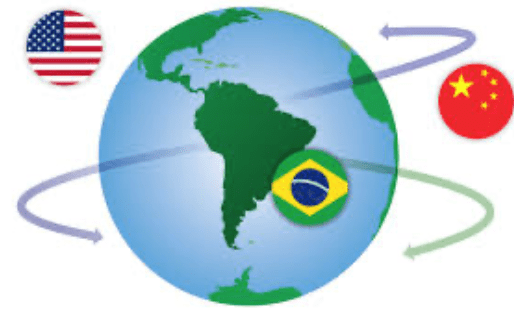
Is Latin America still Washington’s backyard, or has Beijing quietly moved in as a co-architect of the region’s future?
Latin America has long been considered part of the United States’ traditional sphere of influence, a region where kinship by geography once translated into predictable political and economic alignment with Washington. But the early decades of the 21st century have challenged that assumption. Rising Chinese engagement, shifting domestic politics, and recalibrated U.S. foreign policy have combined to reshape the strategic orientations of three of the region’s greatest powers: Mexico, Colombia, and Brazil. As these nations navigate their internal priorities and external pressures, their relations with the United States and China reflect broader geopolitical transformations in the Western Hemisphere.
Mexico’s political course under President Claudia Sheinbaum has marked a nuanced shift toward closer alignment with the United States, but not without complexity. Traditionally Canada’s partner in USMCA trade and heavily integrated into North American supply chains, Mexico still depends on the U.S. for most of its trade and investment. However, rising economic engagement with China in the past decade means that even a turn toward Washington comes with strategic balancing.
In 2025, the Sheinbaum government proposed tariffs on Chinese goods, including cars, steel, and electronics, a move framed as protecting domestic industries yet interpreted by some analysts as Canada-like “siding with Washington’s broader geopolitical agenda.” The proposal’s timing around a key USMCA review underlines how Mexico’s economic interests with the U.S. reinforce geopolitical closeness. But Beijing remains a significant trade partner and investor, a reality Mexico cannot ignore without risking economic costs.
Thus Mexico’s strategy illustrates a broader regional pattern: proximity and economic integration with the United States often trump ideological or political difference, yet strategic autonomy remains a consideration. Mexico’s leadership, while leaning toward Washington on trade and security, still must manage the implications of Chinese commercial and supply-chain integration.
Colombia’s shift is perhaps the most emblematic example of Latin America’s geopolitical recalibration. Historically one of Washington’s closest allies in South America, Bogotá’s foreign policy under President Gustavo Petro has taken a more nuanced approach. Domestic priorities, from social reforms to infrastructure ambitions, have inspired new economic partnerships.
In 2025, Colombia joined China’s Belt and Road Initiative (BRI) and signaled interest in becoming a member of the BRICS’ New Development Bank, a Beijing-initiated multilateral institution designed to provide alternatives to Washington-dominated financial organizations. These decisions, while not full abandonment of ties with the U.S., represent a notable incremental shift in Bogotá’s geopolitical positioning.
Trade patterns reflect this realignment. Though the United States remains an important trading partner, China has rapidly approached, and in some sectors surpassed, U.S. levels as a source of imports for Colombia. That change is not yet a definitive pivot toward Beijing but signifies a broader strategic search for diversified partnerships. Bolstering relations with China has also provoked shifts in U.S. policy toward Colombia, including Washington’s decision to “decertify” some counter-drug cooperation, a move seen as a form of political pressure.
Colombians themselves are increasingly split in their outlook on this geopolitical balancing act. Recent polling suggests that significant segments of public opinion favor stronger ties with China nearly as strongly as those advocating for alignment with the U.S., reflecting how domestic politics and governance debates influence foreign policy choices.
The most dramatic geopolitical shift of the three comes from Luiz Inácio Lula da Silva’s Brazil. Latin America’s largest economy has progressively diversified its strategic partnerships, with China emerging as its foremost economic and diplomatic partner. China now absorbs a large share of Brazilian exports, especially in agriculture and raw materials, even as the United States remains important in other sectors.
During high-level visits in 2025, Brazilian leadership emphasized “indestructible ties” with China, reflecting both economic pragmatism and a geopolitical view that a multipolar world order requires flexible alliances. China’s investments in infrastructure, technology, and development projects have anchored deeper bilateral ties, making Beijing a central player in Brazil’s long-term foreign policy calculus.
Brazil’s reorientation has broader implications. Not only does it signal Latin America’s growing economic interdependence with China, but it also underscores the limitations of U.S. influence when Washington’s own policies, such as tariffs or unpredictable trade behavior, diminish confidence among Latin American partners. In some ways, Brazil’s alignment with Beijing exemplifies a regional preference for pragmatic engagement over ideological loyalty to either superpower.
The evolving political landscapes in Mexico, Colombia, and Brazil demonstrate that Latin America is no longer a passive theater of U.S.–China rivalry. Instead, these countries are active agents shaping their foreign alignments based on domestic priorities, economic interests, and perceptions of global power.
While Mexico fortifies its traditional alliance with Washington out of economic necessity, Colombia quietly diversifies partnerships to balance between two giants, and Brazil, confident in its own economic weight, embraces deeper ties with Beijing. These strategic calculations suggest a Latin America that is increasingly comfortable navigating a multipolar world, even if that means managing tensions between the U.S. and China rather than choosing one over the other.
In the 21st century, the center of gravity in hemispheric diplomacy may no longer lie exclusively with Washington, but with capitals that pursue autonomy, diversification, and pragmatic engagement in global affairs.
——————————————————
References:
(Brenda Estefan, 2025.) https://www.americasquarterly.org/article/how-latin-america-is-realigning/
(Council on foreign relations, 2025.)https://www.cfr.org/articles/china-latin-america-november-2025
(Raisana Debates, 2025.)https://www.orfonline.org/english/research/latin-america-s-tug-of-war-the-pulls-of-the-u-s-china-rivalry
(
 The Bulldogs' Journal