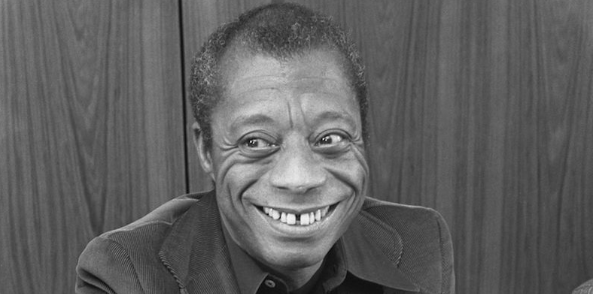
By Oliver Mendez
James Baldwin, pillar in black history, literary giant and advocate of social justice, still remains a beacon of inspiration in the still ongoing quest for equality and understanding. His contributions to literature and activism have cemented his legacy as an influential figure in civil rights. His works still have an enduring impact on contemporary writers and activists. Through the lens of Baldwin, we celebrate the legacy of a man whose words transcend time. However, his life was also filled with controversies, maintaining raw and unapologetic critiques to American race relations, his open homosexuality and radical political views.
Born in Harlem, New York on August 2, 1924. He was raced by his mother and stepfather David Baldwin, a Baptist preacher, originally from New Orleans, Louisiana. The eldest of nine children, maintaining a serious responsibility of being a big brother, protecting his 3 younger brothers and five sisters, in a household governed by his step father’s rigid ruling/
Between 14 and 17, James Baldwin preached at the Fireside Pentecostal Assembly, an experience that later shaped his rhetoric, biblical imagery, and eventual rejection of organized religion. In The Fire Next Time, he wrote that if God cannot make people “larger, freer, and more loving,” then the idea of God should be discarded.
At Douglass Junior High, he was mentored by Countee Cullen, and later at DeWitt Clinton High he immersed himself in literary life, editing the school magazine and forming lasting friendships with future creative collaborators.
After graduating in 1942, Baldwin faced hardship: the 1943 Harlem unrest, his father’s death in 1944, financial struggle, and responsibility for his siblings. He worked day jobs, played guitar in Greenwich Village cafés, and wrote intensely at night.
In 1944, he met Richard Wright, who became a mentor and helped him secure a fellowship to begin his first novel and move to Paris in 1948. Their relationship later broke due to Baldwin’s criticism of Wright’s protest literature.
At 24, Baldwin left the U.S. seeking freedom from racial and sexual hostility, settling in Paris, where he reconnected with Wright and befriended Maya Angelou. The assassinations of Medgar Evers, Malcolm X, and Martin Luther King Jr.deeply affected him. He later settled in Saint‑Paul‑de‑Vence, where he spent his final years writing.
Although Baldwin achieved to convey brilliant works, his life was surrounded by controversy. Many accused him of extremist ideas, sexism and his sexual orientation, making it difficult to follow him. Which set him in an uncomfortable position, being too militant for his formal white liberal friends, too liberal for black radicals, and too gay for either.
This division creates multiple opinions about his works.
In the College Language Association Journal, Therman B. O’Daniel called Baldwin “the gifted professor of that primary element, genuine talent. … Secondly he is a very intelligent and deeply perceptive observer of our multifarious contemporary society. … In the third place, Baldwin is a bold and courageous writer who is not afraid to search into the dark corners of our social consciences, and to force out into public view many of the hidden, sordid skeletons of our society.”
While figures like Eldridge Cleaver, pointed that he isn’t objective and that his desire to depict the complexity of human sociology, was actually as race self-hatred and a “sycophantic” sucking up to whites. “There is in James Baldwin’s work the most grueling, agonizing, total hatred of the blacks, particularly of himself, and the most shameful, fanatical, fawning, sycophantic love of the whites that one can find in the writings of any black American writer of note in our time.”
His works like The Fire Next time are still objects of conversation, profoundly influencing the Civil Rights movement and American literature by offering a different raw analysis of racial injustice. With the sole purpose to reach a massive white audience to help them better understand black american struggle for rights.
Ultimately, James Baldwin remains a complex yet enduring figure — a literary giant whose voice refused silence, compromise, or comfort. His life, marked by controversy, criticism, and isolation, only reinforced the raw honesty that defined his work. Baldwin stood in an uneasy space, often misunderstood, too radical for some, too moderate for others, yet always unwavering in his commitment to exposing the moral contradictions of American society.
Better Living Through Beowulf. (n.d.). Taking a cleaver to nuanced race talk. https://betterlivingthroughbeowulf.com/taking-a-cleaver-to-nuanced-race-talk/
ThaBeardedVulture. (2018, August 13). James Baldwin: A misogynist? Medium. https://medium.com/@ThaBeardedVulture/james-baldwin-a-misogynist-75cf27c3dc92
Charles, R. (2024, August 2). Stop sanctifying James Baldwin. The Stranger. https://www.thestranger.com/books/2024/08/02/79631385/stop-sanctifying-james-baldwin
La Maison Baldwin. (n.d.). The art of activism: Baldwin’s influence on literary and social movements. https://www.lamaisonbaldwin.org/post/the-art-of-activism-baldwin-s-influence-on-literary-and-social-movements
National Museum of African American History and Culture. (n.d.). Introduction to James Baldwin. https://nmaahc.si.edu/explore/stories/introduction-james-baldwin
 The Bulldogs' Journal