By Sebastián Alburquerque – 11th grade
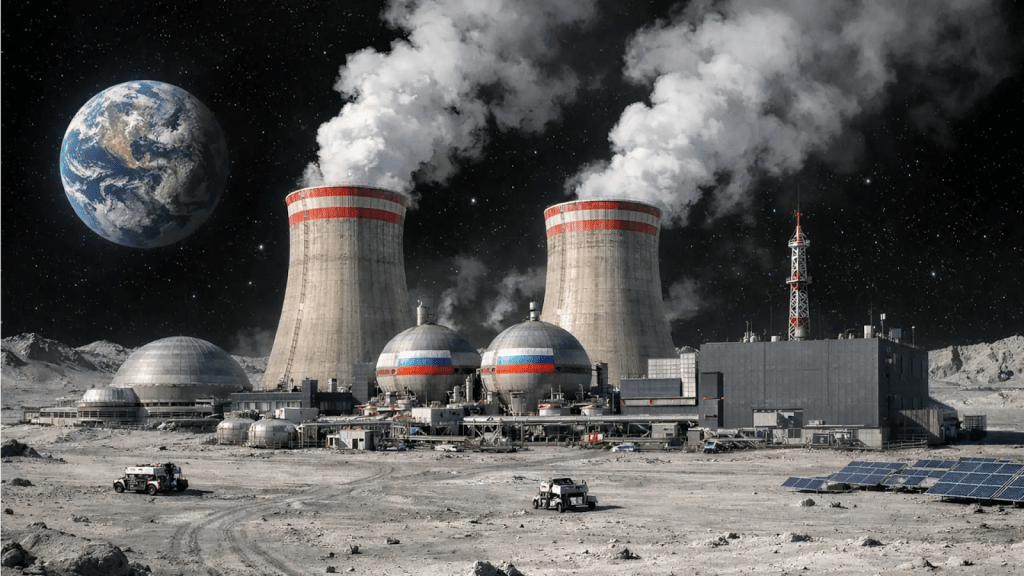
The Russian Space Agency has announced plans to construct a nuclear power station on the lunar surface by 2035. The proposed facility would provide power for Russian spaceflight operations on the Moon, and also as part of a newly established collaborative research base between Russia and China. Design and construction of the proposed facility is being undertaken by the Lavochkin Company, and Roscosmos has indicated that the completed facility will be ready by 2036.
Although the announcement did not explicitly use the term “nuclear,” the involvement of Rosatom (the Russian Nuclear Power Company) and The Kurchatov Institute are clear indications that the planned facility will be using atomic energy.
The facility will be responsible for supplying power to a series of lunar rovers that Russia plans to develop, to provide power to the proposed joint Russian-Chinese Lunar Base, and to power a number of scientific observatories located on the lunar surface. As per the statements provided by Roscosmos regarding the planned nuclear power station on the Moon, the agency believes that this project will represent a major advancement toward establishing a long-term lunar station that can support crewed operations.
For decades, engineers have created concepts for what a lunar base will look like. The concept above shows how inflatable habitats, solar shields, and buildings built using lunar soil might work together. One of the major challenges for any lunar base will be getting power.
Each lunar night lasts approximately 14 Earth days, which means that any solar panels will not be generating power for that entire time. For this reason, many of the space agencies think that nuclear reactors are a viable option, because, according to NASA, a small fission reactor can run for years without needing to be refueled, and it can produce “continuous, sufficient power,” even during the long, cold nights on the Moon.
The Russian space agency Roscosmos has stated that the purpose of the reactor will be to assist in establishing a permanent lunar base, rather than just having multiple lunar missions. The reactor represents an attempt by Russia to reclaim their status in space. Experts say that Russia was once the leader in space exploration, and they sent Yuri Gagarin into orbit in 1961, but in the past few decades, they have “fallen behind” both the United States and China. One of the largest setbacks for Russia during this time was the crash of the Luna-25 lander in 2023, which damaged their lunar program.
The United States Space Agency (NASA) is conducting an independent effort along with the U.S. Department of Energy to deploy a small nuclear power plant on the surface of the Moon by 2030, and they are looking for ways to use nuclear power for the Artemis program. In August 2025, NASA made a public announcement that they would deploy such a system to provide energy for all their future lunar missions.
In addition, the NASA-DOE partnership calls for developing a 40 kilowatt fission reactor that can operate safely for many years; thus, supplying a constant source of energy during the Artemis lunar missions. This project was characterized by U.S. Government officials as having been initiated with the intention of being a part of a competition with China to establish a human presence on the Moon. American Transportation Secretary Shawn Duffy commented on the Moon base’s need for power: “We have to have power!”
With regard to the status of the lunar program, he said, “We are behind in our lunar program. Therefore, we must improve our energy supply system.” Additionally, international law prohibits the placement of nuclear weapons in space; however, it allows for the establishment of nuclear power generation plants provided the plants are operated in accordance with the terms of the treaties. NASA and the DOE state that the use of a nuclear reactor on the Moon will make a human presence on the Moon and on the Earth-Moon system a continuous and viable option because it could generate electricity day and night without interruption, even under conditions of extreme cold and extreme heat.
Numerous nations around the world are seeking to develop and implement nuclear energy systems through the creation of nuclear reactors for use outside of the Earth’s atmosphere. One example of this is China and Russia. Their Lunar programme includes plans to deploy a nuclear reactor on the Moon in the form of an International Lunar Research Station, which they plan to build in conjunction with their Lunar missions.
Additionally, the Chinese Programme’s goal is to send astronauts to the Moon in approximately 2030 and to establish a permanent base through the use of Chang’e missions, pursuing a production resource network for power through electric power systems establishes urgency from other national entities for resources and a future economic model for Lunar Development because of the potential Resource availabilities; In fact, according to NASA Scientists, there may be upwards of 1 Million Metric Tons of Helium-3 as a potential new Energy Source located on the Moon along with potentially large quantities of Rare Earth Elements.
Therefore the development of a Lunar Resource and a Permanent Crewed Lunar Presence will add to the potential for intense competition for lunar resources on the Moon leading to increased value for a continuous Customer Base. Many analysts believe that this increase in industry activity will create an initial impact of compelling interest from multiple nations competing for and supporting the Space Industry, and a new phase of international competition in space
Overall, the two leaders of the Space Orbits or countries who are investing their future success in Space through the Development of Nuclear Reactors on the Lunar Surface (Russia and China) are also the same countries who view nuclear power as a Significant Component of their Long-term vision of Lunar Exploration and a Key to maintain leadership in the future of space.
References:
Reuters. (2025, December). Russia plans nuclear power station on the moon as global lunar race intensifies. Ynet News. https://www.ynetnews.com/environment/article/hyjpnr97wl (Report outlines Roscosmos’s plan to build a lunar nuclear power facility to support long-term moon operations and collaboration with China.)
Newsweek. (2025, December). Russia plans nuclear power plant on the moon to support lunar base by 2036. https://www.newsweek.com/russia-china-moon-nuclear-power-plant-11267635 (Covers Russia’s ambitions to reassert space leadership and mentions past setbacks like Luna-25.)
StratNews Global. (2025, December 24). Russia plans to build nuclear power plant on the moon by 2036. https://stratnewsglobal.com/world-news/russia-plans-to-build-nuclear-power-plant-on-the-moon-by-2036/ (Details Russia’s timetable and strategic context for a lunar nuclear plant.)
Xinhua. (2026, January 28). Russia to launch three modules for lunar nuclear power station by 2035. China Daily HK. https://www.chinadailyhk.com/article/627939 (Reports on the phased module launch plan for the lunar power station.)
Forbes. (2024, March 5). Rusia y China planean construir una central nuclear conjunta en la Luna para 2035. https://forbes.co/2024/03/05/actualidad/rusia-y-china-planean-construir-una-central-nuclear-conjunta-en-la-luna-para-2035/ (Discusses the Roscosmos-CNSA planned joint lunar nuclear project and timeline.)Sputnik News. (2024, June 12). Putin signs law ratifying agreement with China on International Scientific Lunar Station creation. https://en.sputniknews.africa/20240612/putin-signs-law-ratifying-agreement-with-china-on-intl-scientific-lunar-stancii-1067009136.html (Details Russia’s legal ratification of the joint lunar station that includes nuclear energy facilities.)
 The Bulldogs' Journal