Mila Ho 9-ll
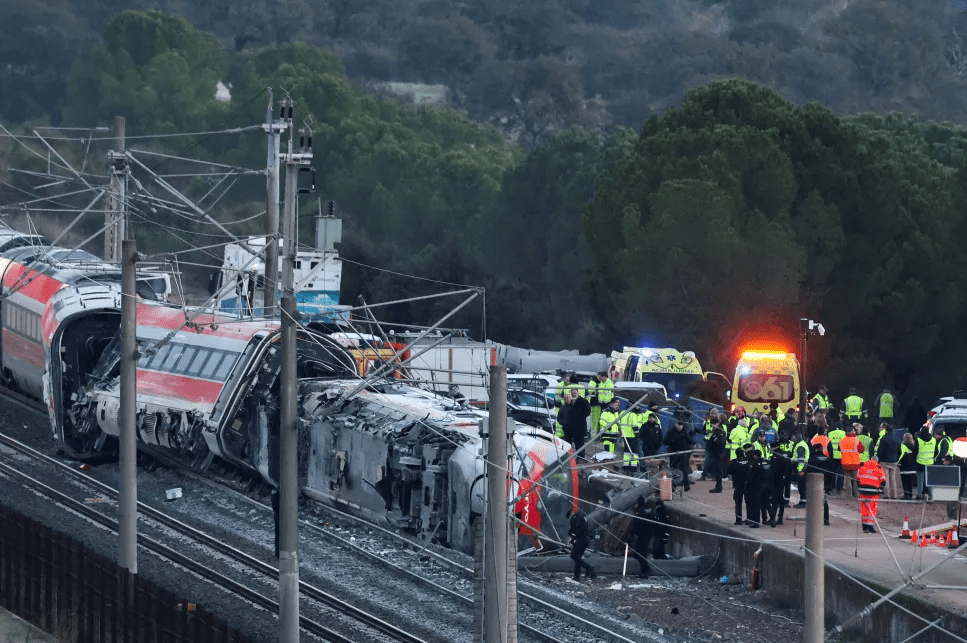
A deadly high-speed train collision in southern Spain killed at least 39 people and injured dozens more, making it the country’s worst rail disaster in over a decade. Authorities have launched an investigation as Spain mourns the victims and questions the cause of the crash.
Spain is mourning after a devastating high-speed train collision in the southern region of Andalusia killed at least 39 people and injured more than 150 others, marking the country’s worst rail disaster in over a decade. The crash occurred on Sunday evening near the small town of Adamuz, close to the city of Córdoba, sending shockwaves across the nation and prompting a large-scale rescue and investigation effort.
The collision happened at approximately 7:45 p.m. local time when the rear carriages of a northbound high-speed train traveling from Málaga to Madrid derailed on a straight section of track. The derailed carriages crossed into the opposite line and slammed into a southbound train operated by Renfe, which was traveling from Madrid to Huelva. Both trains overturned as a result of the impact, with several carriages plunging down an embankment.
Around 400 passengers and staff were on board the two trains combined. Emergency services treated at least 152 people for injuries, while 43 remain hospitalized, including 12 adults and one child in intensive care. Authorities have warned that the death toll may still rise as rescue crews continue to remove twisted wreckage and search the site.
Survivors described scenes of terror and confusion. Rocío Flores, who was on the southbound train, said passengers were “thrown through the air” during the collision. Another survivor, Ana, recalled how her train tipped violently before everything went dark. Covered in blood, she was pulled through a window by fellow passengers, while firefighters worked for hours to rescue her sister from the wreckage. “You had people right in front of you and you knew they were going to die, and you couldn’t do anything,” she said.
Rescue efforts were severely hampered by the condition of the carriages, many of which were crushed or tangled together. Córdoba fire chief Francisco Carmona described the work as “hard and tricky,” explaining that rescuers sometimes had to remove bodies to reach survivors. The sound of mobile phones ringing inside the wreckage echoed through the scene as desperate relatives tried to contact loved ones trapped inside.
In Adamuz, a town of just over 4,000 residents, the local community mobilized quickly. A sports center was converted into a makeshift hospital, while the municipal building was stocked with blankets and supplies. Residents from nearby towns also arrived to help. “The whole town rallied to help,” said local resident Mónica Navarro. “People came with blankets and anything they could bring.”
Spanish Prime Minister Pedro Sánchez canceled his scheduled trip to the World Economic Forum in Davos and traveled to the crash site on Monday. Declaring three days of national mourning, he promised a full and transparent investigation. “We will find the answer, and when it is known, with absolute clarity, we will inform the public,” Sánchez said, adding that the government would support victims and their families for as long as necessary.
Transport Minister Óscar Puente described the crash as “extremely strange,” noting that it occurred on a straight stretch of track that had recently undergone renovations as part of a €700 million infrastructure investment. He said both trains were traveling below the speed limit of 250 km/h, with one moving at 205 km/h and the other at 210 km/h. The trains involved were relatively new, including a Frecciarossa 1000 model capable of reaching much higher speeds.
Despite this, the cause of the crash remains unknown. An official investigation has been launched, though Puente warned it could take at least a month before conclusions are reached. Spain’s train drivers’ union, Semaf, has previously raised concerns about vibrations and wear on high-speed rail lines, calling for reduced speed limits. While it is unclear whether those concerns are linked to this incident, the stretch of track involved reportedly underwent maintenance in May.
Rail services between Madrid and Andalusia were suspended following the crash, causing widespread disruption. Adif, the rail network operator, set up assistance centers at major stations including Madrid’s Atocha, Seville, Córdoba, Málaga, and Huelva to support families seeking information. The Spanish Red Cross deployed emergency teams and provided psychological support to relatives, many of whom faced hours of uncertainty.
Condolences poured in from across Europe and beyond. King Felipe VI and Queen Letizia said they were following developments “with great concern,” while French President Emmanuel Macron, Italian Prime Minister Giorgia Meloni, and European Commission President Ursula von der Leyen expressed solidarity with Spain.
The tragedy has reopened painful memories of Spain’s 2013 Galicia train crash, which killed nearly 80 people. Although Spain has one of the largest and most advanced high-speed rail networks in the world, the disaster is a stark reminder that even modern systems are not immune to catastrophic failure. As the nation grieves, many are now demanding answers to ensure such a tragedy never happens again.
SOURCES
 The Bulldogs' Journal