By Amelia Colón, 10th grade.
In the latest release from the Global Mind Project, the Mental Health Quotient (MHQ) of the Dominican Republic is the best amongst all nations. A country that allocates less than 1% of its budget to mental health, according to the Ministry of Public Health and Social Assistance, is leading in happiness. How could this be?
The positive mental health of the Dominican population has more to do with the typical customs and the culture of the country than anything else.
First of all, Sapien Labs (the organization in charge of the project) has found that the most economically challenged countries scored the highest. This contradicts popular beliefs about mental health investment and that more developed countries have more tools to deal with a struggling population. Apart from this, it was previously believed that the more money people have, the more satisfied they tend to be. However, the causes behind this struggle are often overlooked.
The fact that poorer countries have a higher MHQ than developed ones indicates that the population in developed countries can afford to do certain things that aren’t necessarily beneficial for their mental health, for example, afford phones and electronic devices.
A study by Yale ‘23 found that “youth who spent the most time on their digital technology were statistically more likely to exhibit higher levels of internalizing problems two years later. Internalizing problems include depression, anxiety, social anxiety, somatic complaints, and other concerns.” Exposure to the internet has been linked to mental health concerns, and so it’s reasonable that countries with less resources to grant their children access to this internet have higher mental health scores.
Apart from this, a study based on Ghana found that there is a link between strong social connections and happiness. Individuals with social connections with neighbors, or with a strong community around them, report being happier than those who don’t. “Social interactions help people deal with mental health issues such as anxiety and provide emotional support in tough times. This helps people overcome adverse circumstances that may occur, which could make them unhappy,” the study said. Having access to social media is known to prevent this from happening.
According to Baylor Scott, “Social media use displaces more authentic social experiences because the more time a person spends online, the less time there is for real-world interactions.” Because of this, access to social media has been found to have the opposite effect found for early smartphone users, as stated by Sapien Labs, ”Mental wellbeing consistently improved with older age of first ownership of a smartphone or tablet”.
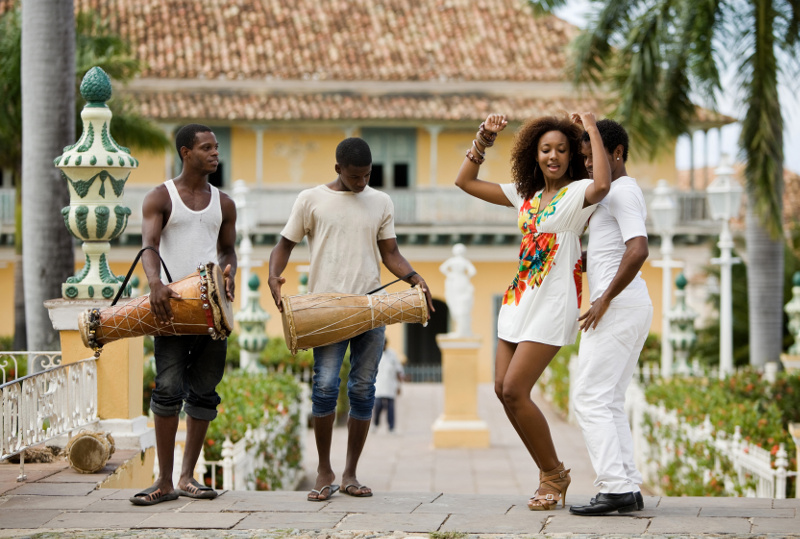
This might not the only reason the Dominican Republic is the happiest nation. Another important reason is the culture’s emphasis on social connections and a supportive community. Getting together is built into Dominican culture. From christmas to mother’s day, dominicans will use every and any reason to get together with family and friends to celebrate. Not only this, but our culture’s traditional music, like merengue, salsa and bachata, are themselves lively and made to be danced to. Dominicans are also known internationally for being welcoming and kind, even to people they don’t know. This, along with the beautiful view, is part of what makes this achievement possible.
The Dominican Republic is the happiest country in the world because of many factors. These also coincide with the trends and patterns that Sapien Labs found themselves, such as economically challenged countries having higher MHQs. Along with their findings on the effects of owning devices like tablets or cellphones at a young age, we can perhaps see that having a poorer population makes it harder for everyone to have access to social media, contributing to better mental health. Not only this, but kindness and celebration is built into Dominican culture, building a stronger, happier community nation-wide.
Sources:
Canablue. (2024, March 12). Dominican Republic: Leading the world in happiness. https://canablue.com/dominican-republic-leading-the-world-in-happiness/#:~:text=With%20an%20impressive%20average%20Mental,country%20on%20the%20global%20stage.
Study probes connection between excessive screen media activity and mental health problems in youth. (2023, March 21). Yale School of Medicine. https://medicine.yale.edu/news-article/yale-study-probes-connection-between-excessive-screen-media-activity-and-mental-health-problems-in-youth/#:~:text=It%20found%20that%20youth%20who,somatic%20complaints%2C%20and%20other%20concerns.
Atta-Ankomah, R., Adjei-Mantey, K., Asante-Poku, N. A., & Agyei-Holmes, A. (2024). What Makes People Happy with their Lives in Developing Countries? Evidence from Large-Scale Longitudinal Data on Ghana. Applied Research in Quality of Life. https://doi.org/10.1007/s11482-024-10287-z
Why social media is making me anti-social. (n.d.-b). Baylor Scott White Health. https://www.bswhealth.com/blog/social-media-making-anti-social
Age of First Smartphone/Tablet and Mental Wellbeing Outcomes. (2023). In Sapien Labs. Retrieved September 25, 2024, from https://sapienlabs.org/wp-content/uploads/2023/05/Sapien-Labs-Age-of-First-Smartphone-and-Mental-Wellbeing-Outcomes.pdf
Study probes connection between excessive screen media activity and mental health problems in youth. (2023b, March 21). Yale School of Medicine. https://medicine.yale.edu/news-article/yale-study-probes-connection-between-excessive-screen-media-activity-and-mental-health-problems-in-youth/#:~:text=It%20found%20that%20youth%20who,somatic%20complaints%2C%20and%20other%20concerns
 The Bulldogs' Journal